chatcast
The Falcons are killing us
An episode cut from a real group chat. Nobody wrote a line of it: the engine read the thread off the machine it lives on, worked out who everyone is from how they type, and performed what they actually said — in their own voices and faces.
The episode
Every one of the eleven people in this chat, in one episode. Falcons talk is the only subject the whole room shows up for, so the lines are compiled from across 5,779 messages of it. The room is 3,060px wide against a 1280px frame — the camera travels, because shrinking eleven people to fit makes every face too small to read.
- 0:02 Chad Crane What time do the falcons play
- 0:04 Ryan Abram Looks like the Falcons just trying to lose
- 0:06 Matt Fairchild Go Dirty Birds!
- 0:08 Matt Fairchild Good ole fashion ass kicking! Go Falcons!
- 0:12 Matt Fairchild Falcons are division winners easily with Joe Flacco or no?questioning
- 0:16 David I hate the falcons
- 0:18 Matt Fairchild Man that Blank/McKay PC was brutal. No Fontenot there. They didn't answer any questions. Falcons are fucked. Horrible leadershipannoyed
- 0:29 Matt Fairchild Let's be honest: Falcons are fuckedannoyed
- 0:32 John Fox Jaguars Defense is going to be damn good with Ryan Nielsen, he did a hell of a job with the Falcons this year.annoyed
- 0:38 Gary Vogt If we trade the farm for this guy I'm never watching the falcons again
- 0:43 William Cox Jack browning is unrestricted FA and nobody is talking about him. Falcons could sign for league minimum. No trades, sign him and we are solid
- 0:53 Matt Fairchild If the Falcons can get Kupp and their first round pick to move down to 19 you fucking do itannoyed
- 0:59 Chuck Sharp John you should apply for the head coach for the Falcons and a side gig take over for Bobo. I think you would be great.
- 1:06 Matt Fairchild Falcons need to sign that Norway goalie. Holy shit he kicked that ball 80 yardsannoyed
- 1:12 Jason Duke Wait what H & B. I just got off the boat. Where em I headed ATL ? Just cleaned up the boat.emphatic
- 1:20 Chuck Thaxton Falcons fuck guys, they are gay.annoyed
- 1:23 John Fox Fuck ND pieces of shitstanding bit · he says one of these every episode
- 1:26 Matt Fairchild Heading to Roswell to get some oysters and watch the Falcons do some gay shitannoyed
- 1:30 Mark Haas Were going to fuck then up and the falcons are going to hang 40 on Baltimoreannoyed
Delivery is read off the punctuation. Block capitals is a shout, four question marks is incredulous, “lmaooo” is a laugh. Voices are matched on how each man types — and which voices are male was stated by the chat's owner, never guessed from a name.
The standing bit
Some jokes are about a person, not a subject. John Fox says something terrible about Notre Dame in every episode, whatever the episode is about — it is a rule, not a search, and it is funnier here than it would be in an episode about Notre Dame.
This one is called Where Do I Eat. It is about cheesesteaks. At 45 seconds he says this to nobody, and everyone carries on talking about where to get a pizza.
The line rotates between episodes — Fuck ND · ND pays to play · ND pays to win · Fuck ND pieces of shit — so the gag recurs without repeating, and it is skipped entirely in an episode already about Notre Dame.
The cast
A photograph on the left, the character it produced on the right. The traits underneath are measurements of how that person types — not a description anyone wrote.

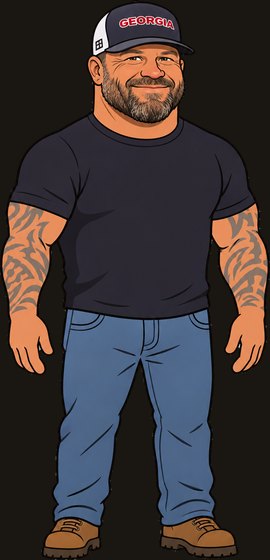

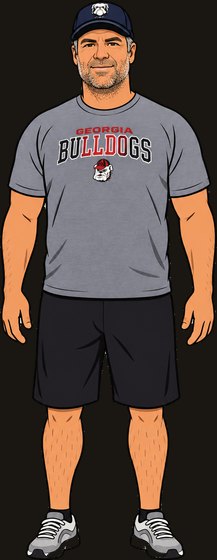

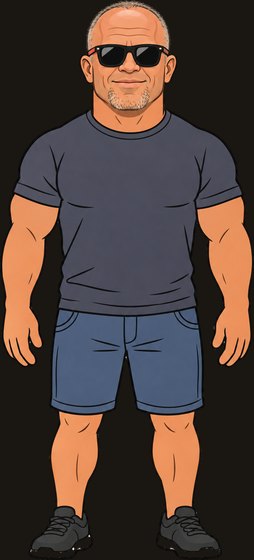

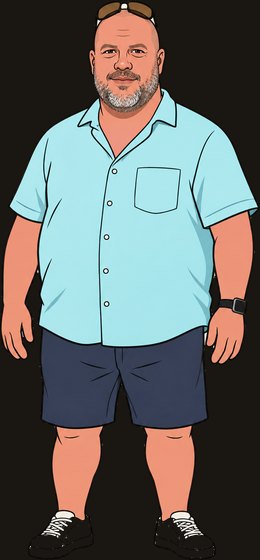

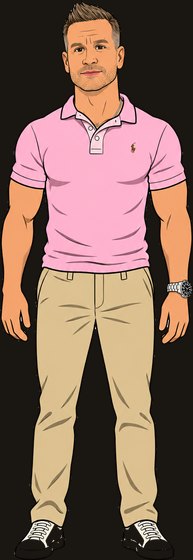
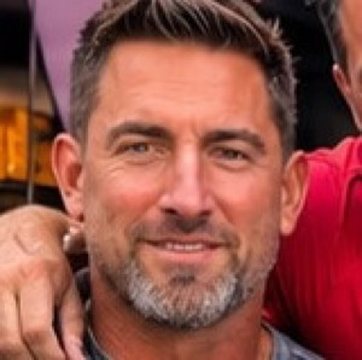
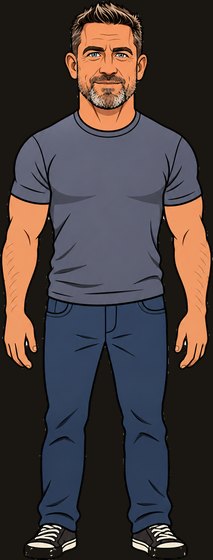
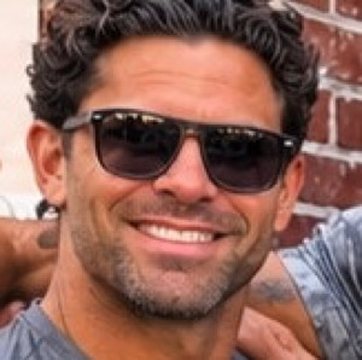
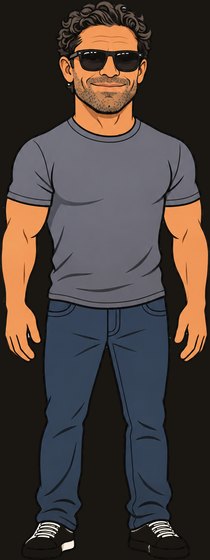
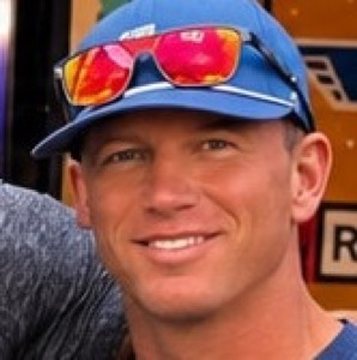
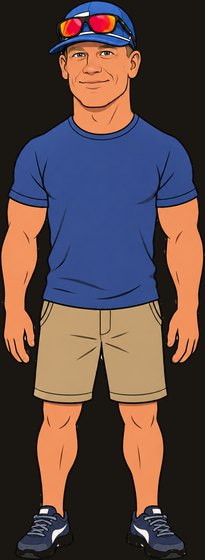
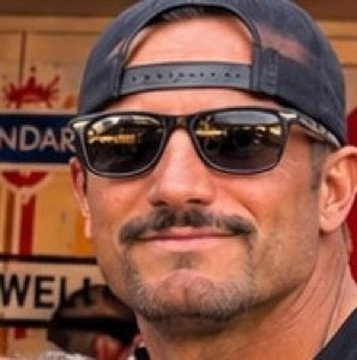
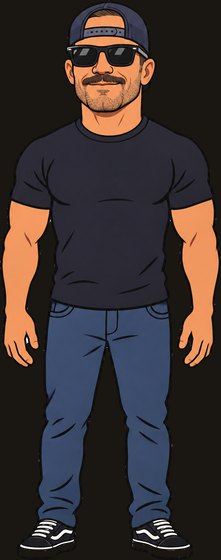
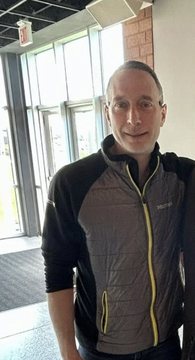
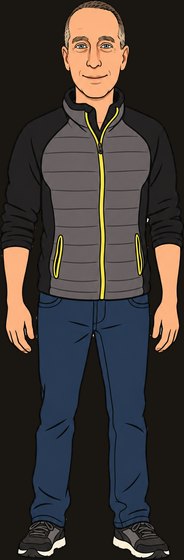
3 still without a face: William Cox, Jason Duke, +17703556103. They appear as neutral stand-ins rather than a guess at what they look like.
How a mouth works
Each person has a chart of eight mouth shapes, drawn in isolation from their own artwork and composited onto their face — so their beard, chin and skin are never painted over. Forced alignment picks which one to show, frame by frame.

Closed · slight · open · wide · round · pucker · f/v · tongue — nothing but the mouth, so nothing around it has to match.
What runs, in order
Read
chat.dbThe thread is parsed on the machine it lives on. Modern messages keep their text in an archived blob, not the text column — a reader that checks only the obvious field sees a conversation full of holes.
Measure
who.mjsPace, volume, who starts things, who only ever reacts. Traits are relative to this group: the loudest person in a real chat shouts in 5% of messages, not 25%.
Find the bit
bits.mjsA run that escalates and then lands, scored across every window in the thread — and forbidden from crossing a conversation break, of which this chat has 2037.
Standing bits
standing.mjsSome jokes are about a person, not a subject. John Fox says something terrible about Notre Dame in every episode whatever it is about — it is a rule, and it is funnier in an episode about the Falcons than one about Notre Dame.
Or the running bit
theme.mjsSome jokes are not a run at all. A grievance somebody has carried for a season lives in scattered lines hundreds of messages apart; compiled on the subject, the accumulation is the joke.
Cast
casting.mjsA distinct voice per person out of 84, matched on those same measurements. No two people share one, because a doubled-up cast is its own kind of monotone.
Draw
gen.mjsOne photograph becomes a flat-vector character. Likeness is the whole job: the hairline, the beard, the cap, the sunglasses — those are who someone is, not props to drop.
Locate
spec.mjsVision finds the eyes and mouth on the drawing, so nobody measures it by hand. Five of six first try; the sixth, bald in sunglasses, is derived from the face box.
Chart
chart.mjsEight mouth shapes per person, drawn alone on white. Asking for the lower face instead got eight different beards, none of them the one on the character — a visible patch around every mouth.
Sync
visemes.mjsForced alignment against each line's own text. Real phoneme timing, never an amplitude envelope — a jaw that bounces with the volume looks like chewing.
Cut and pan
camera.mjsShort lines land in close-up, long ones need the room, and the framing never repeats twice running. With a cast too wide for the frame the camera travels between speakers rather than cutting — seeing who is in between is most of the joke in a group argument.